
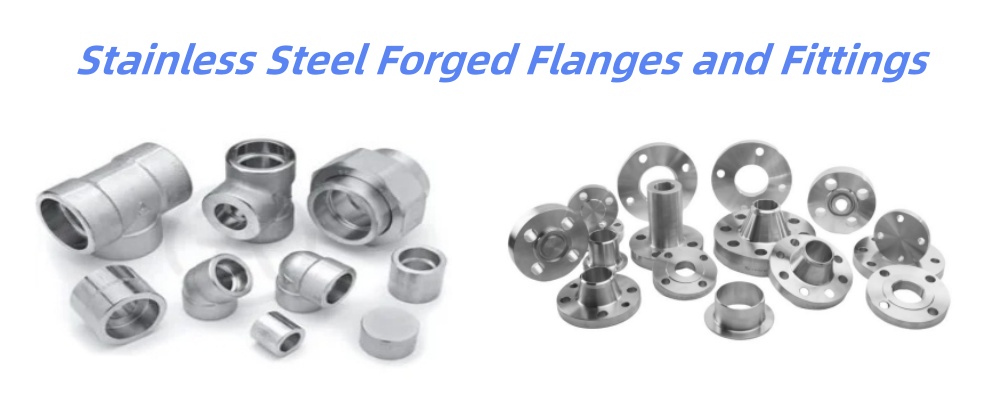
Stainless steel forged flanges and fittings are high-strength connection components manufactured from stainless steel raw materials through processes such as high-temperature forging, machining, and heat treatment. They are widely used in industrial pipeline systems across industries such as petroleum, natural gas, chemicals, power, shipbuilding, pharmaceuticals, and food processing.
ZIZI is a trusted manufacturer and supplier of stainless steel pipe fittings, offering a wide range of products including elbows, tees, reducers, caps, flanged short sections, and flanges. Our fittings and flanges are manufactured in accordance with ASME B16.11, ASME B16.5, DIN, and JIS standards to ensure high quality, dimensional accuracy, and long-lasting performance. Our products are made from corrosion-resistant materials such as 304/304L, 316/316L, and duplex stainless steel, designed to maintain durability in the most demanding environments. All stainless steel fittings and flanges undergo rigorous quality inspections and are available in various sizes, thicknesses, and pressure ratings. With technical expertise and efficient logistics support, ZIZI provides precision components and seamless connections to global customers.
Features
Material Advantages: Made of stainless steel, it offers excellent corrosion resistance and can withstand erosion from various media such as acids, alkalis, and salts, making it suitable for environments with strong corrosive conditions.
Long Service Life: Stainless steel inherently possesses good oxidation resistance and wear resistance. Combined with high-quality forging processes, stainless steel forged flanges have a longer service life, reducing replacement costs.
Excellent Material Performance: Also made of stainless steel, it offers excellent corrosion resistance and can adapt to various harsh medium environments.
High Structural Strength: The forging process imparts high strength and hardness to the fittings, enabling them to withstand significant pressure and impact forces, ensuring stable performance in high-pressure pipeline systems.
Wide Range of Applications: Fittings can be produced in various specifications and models according to different pipeline design requirements, meeting usage needs under different pressure, temperature, and medium conditions.
ASTM A182 Datasheet
Chemical Properties %
| CHEMICAL | LIMITS | C | Mn | P | S | Si | Ni | Cr | Mo | N | Ti |
| ASTM A182 F304 | MIN | 8.0 | 18.0 | ||||||||
| MAX | 0.08 | 2.00 | 0.045 | 0.030 | 1.00 | 11.0 | 20.0 | 0.10 | |||
| ASTM A182 F304H | MIN | 0.04 | 8.00 | 18.00 | |||||||
| MAX | 0.10 | 2.00 | 0.045 | 0.030 | 1.00 | 11.00 | 20.00 | ||||
| ASTM A182 F304L | MIN | 8.00 | 18.00 | ||||||||
| MAX | 0.03 | 2.00 | 0.045 | 0.030 | 1.00 | 13.00 | 20.00 | 0.10 | |||
| ASTM A182 F316 | MIN | 10.0 | 16.0 | 2.00 | |||||||
| MAX | 0.08 | 2.00 | 0.045 | 0.030 | 1.00 | 14.0 | 18.0 | 3.00 | 0.10 | ||
| ASTM A182 F316L | MIN | 10.00 | 16.0 | 2.00 | |||||||
| MAX | 0.03 | 2.00 | 0.045 | 0.030 | 1.00 | 15.00 | 18.0 | 3.00 | 0.10 | ||
| ASTM A182 F317 | MIN | 11.00 | 18.00 | 3.00 | |||||||
| MAX | 0.08 | 2.00 | 0.05 | 0.03 | 1.00 | 15.00 | 20.00 | 4.00 | |||
| ASTM A182 F321 | MIN | 9.00 | 17.00 | 0.10 | 5(C+N) | ||||||
| MAX | 0.08 | 2.00 | 0.05 | 0.03 | 1.00 | 12.00 | 19.00 | 0.70 | |||
| ASTM A182 F321H | MIN | 0.04 | 9.00 | 17.00 | 4(C+N) | ||||||
| MAX | 0.10 | 2.00 | 0.045 | 0.030 | 1.00 | 12.00 | 19.00 | 0.7 | |||
| ASTM A182 F347 | MIN | 9.00 | 17.00 | ||||||||
| MAX | 0.08 | 2.00 | 0.045 | 0.030 | 1.00 | 13.00 | 20.00 | ||||
| ASTM A182 F904L (N08904) | MIN | 23.00 | 19.00 | 4.00 | |||||||
| MAX | 0.02 | 2.00 | 0.040 | 0.030 | 1.00 | 28.00 | 23.00 | 5.00 | 0.10 |
Mechanical Properties
| MATERIAL | ASTM A182 F304 | ASTM A182 F304H | ASTM A182 F304L | ASTM A182 F316 | ASTM A182 F316L | ASTM A182 F317 | ASTM A182 F321 | ASTM A182 F321H | ASTM A182 F347 | ASTM A182 F904L |
| T.S (MPA) | 515 min | 515 min | 485 min | 515 min | 485 min | 515 min | 515 min | 515 min | 515 min | 490 min |
| Y.S (MPA) | 205 min | 205 min | 170 min | 205 min | 170 min | 205 min | 205 min | 205 min | 205 min | 215 min |
| EL % | 30 min | 30 min | 30 min | 30 min | 30 min | 30 min | 30 min | 30 min | 30 min | 35 min |
| R/A % | 50 min | 50 min | 50 min | 50 min | 50 min | 50 min | 50 min | 50 min | 50 min |
Stainless Steel Forged Flanges
Flanges are disc-shaped or ring-shaped parts used to connect pipes, valves, pumps, and other equipment, forming an integrated pipe system through bolt connections.
Stainless steel forged flanges are manufactured from stainless steel materials (such as 304, 316, 316L, etc.) through a forging process. Compared to cast flanges, the forging process eliminates internal defects in the metal, resulting in a denser structure, finer grain size, and better mechanical properties, enabling them to withstand higher pressures and temperatures.
Stainless Steel Flange Types
Weld Neck Flange
Slip On Flange
Blind Flange
Socket Weld Flange
Threaded Flange
Lap Joint Flange
Stainless Steel Forged Fittings
Fittings are components used to change the direction or diameter of pipes or to connect branches. Stainless steel forged fittings are also manufactured using forging techniques and offer similar advantages to forged flanges. They are critical components for ensuring the integrity and reliability of piping systems.
Stainless Steel Forged Fittings Specification
Specifications : ASTM A182 / ASME SA182
Standard : ASME B16.11, MSS-SP-79, MSS-SP-83, MSS-SP-95, MSS-SP-97, BS3799
Size : 1/8″ NB to 4″ NB
Type : Socket weld Fittings, Threaded Fittings
Rating Pressure : Threaded End – 2000 /3000/ 6000 LBS. Socket-weld End – 3000 / 6000/ 9000 LBS.
Types of Stainless Steel Forged Fittings
The fitting has an internal bore (socket) into which the pipe is inserted. The connection is then made by a fillet weld on the exterior of the fitting. This means the weld is outside the pipe, preventing it from affecting the pipe’s inner diameter.
Typically available in Class 3000 LBS, 6000 LBS, 9000 LBS, etc.
Socket Weld Cap
Socket Weld Elbow
Socket Weld Tee
Socket Weld Cross
Socket Weld Coupling
Socket Weld Union
The fitting has internal or external threads (usually NPT or BSPT standards) that connect to the pipe via a threaded connection.
Typically available in Class 2000 LBS, 3000 LBS, 6000 LBS, etc.
Threaded Elbow
Threaded Tee
Threaded Cross
Threaded Coupling
Threaded Cap
Threaded Union
Threaded Nipple
Threaded Hex Nipple
Threaded Swage Nipple
Threaded Plug
Threaded Bushing
Applications
Chemical and Petrochemical Industries
Oil and Gas Industry
Food Processing and Pharmaceutical Industries
Power Generation
Water Treatment and Wastewater Facilities
Pulp and Paper Manufacturing
Marine Engineering
General Industrial Applications
Manufacturing Process: Forging vs. Casting
Forging
By heating stainless steel billets and then applying external pressure (such as hammering or stamping), plastic deformation occurs, ultimately forming the final shape.
Performance Characteristics:
High strength and toughness: Forged parts have a uniform and dense internal structure, enabling them to withstand higher pressures, impacts, and fatigue loads.
Durability: Forged components have a long service life and are particularly suitable for long-term use in harsh conditions such as high temperatures, high pressures, and high stresses.
High strength and toughness: The strength and impact resistance of forged components far exceed those of castings.
Better sealing performance: Forged components lack casting defects such as porosity and inclusions, ensuring no leaks at connection points.
Durability: The structure is more compact, resulting in a longer service life.
Casting
Stainless steel is heated to a molten state and then poured into a pre-prepared mold. After cooling and solidifying, it is demolded to form the final product.
Performance characteristics:
Lower mechanical properties: Due to potential internal defects, castings typically have lower strength, toughness, fatigue strength, and impact resistance compared to forgings.
Prone to defects: Internal defects such as porosity, shrinkage cavities, and inclusions may exist, affecting strength and sealing performance.
Poor sealing performance: Internal defects may serve as potential pathways for fluid leakage, posing greater risks under high-pressure conditions.
Conclusion:
Although the casting process is cost-effective, for critical applications in industries such as petroleum, chemicals, and nuclear power that demand the highest levels of safety and reliability, the forging process is undeniably the preferred choice. Its superior mechanical properties and sealing performance ensure the long-term stable operation of pipeline systems and minimize safety risks to the greatest extent possible.